Motivate Your Team! Cheer Up A Friend! Inspire Yourself!
Motivate Your Team! Cheer Up A Friend! Inspire Yourself!
 |
|
| Wooden's Wisdom - Volume 13 | Issue 764 |
| Craig Impelman Speaking | Championship Coaches | Champion's Leadership Library Login | |
|
GEORGE WASHINGTON CARVER 1 OF 3 (TONY FULLER) "THE MAN WHO LIVED THE CREED!" BE TRUE TO YOURSELF. John Wooden Video Clip (2 min. 20 sec.): Coach Wooden defines Self-Control. When our author Tony Fuller began telling me about the extraordinary life of George Washington Carver, I realized I knew only a small part of his remarkable story. Most people remember Carver as the "peanut scientist," but he was far more than that.
Few Americans have been more widely honored for lives of service than George Washington Carver. He would become one of the nation's most respected scientists and educators, eventually earning a national monument, a U.S. postage stamp, commemorative coins, and countless other tributes recognizing a life devoted to helping others.
Coach Fuller has written an inspiring three-part series for Wooden's Wisdom about this extraordinary American. Here is Part One.
"Use your knowledge to serve others." - George Washington Carver
"Success isn’t what you get, it’s what you give." - George Washington Carver
Coach Wooden’s 7-point Creed gave words to the principles that George Washington Carver lived by.
George was born into slavery around 1864 on the Diamond Grove, Missouri farm of Moses and Susan Carver. He and his older brother Jim stayed on the farm and were raised by the Carvers as their own children after Emancipation. Young George was weak and frail physically, but showed astonishing intellect and skill at cultivating plants, making clothes, playing music, and painting beautiful portraits.
George was around 12 years old when he left the Carver farm on foot to attend a school for colored students that was about 12 miles away in the town of Neosho.
For the next 20 years of his life he would work hard, encounter helpful mentors, overcome setbacks, attend school in Fort Scott, Kansas, be denied admission upon his arrival to Highland College because of his race, enroll at Simpson College in rural Iowa, work as a Sod-Buster on a farm, graduate from high school, become the first black graduate of Iowa Agricultural college in Ames Ia, become a member of IAC’s faculty, earn a master’s degree in 1896, and enroll into IAC’s PHD program!
Along the way he was winning awards and making a name for himself as this unbelievably intelligent scientist, artist, botanist, and inventor that could do and/or create anything! Offers came from across the country for him to leave IAC. He never considered any of them and life was great, until one day in 1896 he opened a letter that read:
"I CANNOT OFFER YOU MONEY, POSITION, OR FAME. THE FIRST TWO YOU HAVE. THE LAST, FROM THE PLACE YOU NOW OCCUPY, YOU WILL NO DOUBT ACHIEVE. THESE THINGS I NOW ASK YOU TO GIVE UP. I OFFER YOU IN THEIR PLACE, WORK, HARD WORK - THE TASK OF BRINGING A PEOPLE FROM DEGRADATION, POVERTY, AND WASTE INTO FULL MANHOOD."
Sincerely,
Booker T. Washington
Principle, Tuskegee Institute, Tuskegee Alabama.
#1 on Coach Wooden’s seven-point creed is : "Be True to yourself". George Washington Carver always believed that his many gifts were God given, and that he was a mere vessel and the Lord’s way to help others. He was a man of great faith and felt that the offer from Tuskegee was the door that would lead to his life’s purpose.
He made the decision to accept Booker T. Washington’s offer, and he headed to rural Alabama to become the Chair of the Agricultural Department at struggling, underfunded, no Lab, no equipment, no facilities having, Tuskegee Institute, for an annual salary of $1000 plus room and board, in a second story on campus dormitory suite.
Iowa Agricultural College (Iowa State University) was far more advanced and comfortable than Tuskegee in every way shape and form, yet Dr. Carver stayed true to himself and gave it all up to join Booker T. Washington in the hard work, challenge, and sacrifice he knew he would face at Tuskegee!
He left the Carver farm in 1876. He left Iowa Agricultural College in 1896, but he never left his Tuskegee position or dormitory suite until his death in 1943.
#3 on Coach Wooden’s seven-point creed is: Help Others…. In our next article we will explore examples of how Dr. Carver helped others during the course of his incredible life!
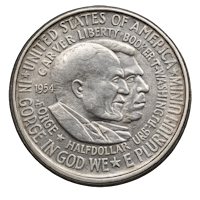
Coach Fuller George Washington Carver - Booker T. Washington
Commerative Half Dollar (U.S. Mint produced 1951-1954)
Yours in Coaching, Craig Impelman
|
Casey's Revenge There were saddened hearts in Mudville for a week or even more; —Grantland Rice (1880–1954)
|
|
For more information visit www.woodenswisdom.com |
|
© Copyright 2026 WoodensWisdom.com | # of Times Wooden's Wisdom Issues Opened: 8,163,364
Hosting & Design by:EverydayWebDesign.com